Nothing Moves Until You Do
A browser tab is an interruption waiting to happen. Something arrives, somebody speaks, another tab wants attention, and the game is still there running or not running depending on a property nobody advertises: whether the game state advances when you are not touching it.
That is the useful split for anyone who plays in a browser rather than in front of a console. Not casual against hardcore, not short against long. Real-time against turn-based, where turn-based is read broadly to mean that the position holds still until you change it. A game with that property can be left mid-move for four minutes or four hours and lose nothing. A game without it turns your attention into a resource, and the moment you stop supplying it the run is over.
What the evidence actually supports
Before the list, a word about how firm any of this is, because there are two very different grades of evidence here and treating them as one would be dishonest.
Some evidence is positive. A description that uses the words turn-based, or states a loss condition made of moves rather than seconds, or names a game whose rules are turn-taking by definition — checkers, tic tac toe, a chess variant — gives you something firmer than a guess.
More often the evidence is negative: the description simply never mentions a clock. That is weaker. A blurb that does not mention a timer is not proof that no timer exists — publisher copy leaves out far more than it puts in, and the absence of a word is not the presence of a fact. Where that is all we have, this article says so rather than upgrading a silence into a guarantee. Nobody here has played these games, and a stopped clock is exactly the kind of claim that would need playing them to confirm.
Games that state the turn
Dark Chess is the most interesting entry and its publisher explains why in two sentences: the pieces come from Chinese chess, the rules do not. Rank decides everything, a piece can only capture something below it in the hierarchy, and you lose when your pieces are gone or you have no legal move. Both of those loss conditions are positional. Neither of them can happen while you are away from the keyboard.
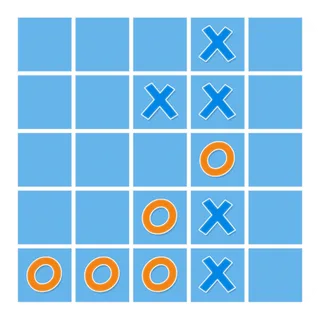
Checkers Legend does something a lot of browser board games skip and exposes a rules setting, because checkers comes in many variants and its publisher says so as the reason the setting exists. It offers a simple computer opponent or a second person on the same device. Tic Tac Toe HTML5 is here for its two larger boards rather than its three by three, which is a solved game everyone already knows; on the five by five and seven by seven boards you place four marks instead of three, and the result stops being a foregone conclusion. Tic Tac Toe Multiplayer offers the same game with an online mode, a computer opponent and a pass-the-device mode, which as it turns out matters a great deal for this article and is covered below.
My Sugar Factory is the clearest statement of the whole principle, because its publisher uses the words: a turn-based game about managing a sugar factory, starting from a single sugar cane bush and running through a factory and a laboratory. A management game that is explicitly turn-based is a rare thing in this catalogue, and it is the closest anything here comes to a guarantee that the numbers are not moving while you are gone.
Intergalactic Battleship is included as a caution, because it looks like the safest entry on this page and is not. What its publisher actually says is that you locate and destroy an enemy fleet on a grid before your own fleet is eliminated. It never states that turns alternate. Everything you feel you already know about how this game runs comes from the paper game it is named after, not from this description of this build, and one of the easier ways to be wrong about a browser game is to answer a question about it from the series rather than from the record in front of you. It stays on the list because a hidden grid narrowed by deduction is not a structure a clock usually sits on top of. That is a judgement, and it is a weaker one than everything above it.
Boards that only change when you change them
The second group is puzzles, and here the evidence is the negative kind. What each description states is a set of legal moves and a failure condition, and none of them mentions a clock. Read that as an absence of evidence rather than as a promise.
Lipuzz is water sort with an escape hatch: pour between containers until each holds one colour, where the pour is only legal onto empty space or onto its own colour, and take an extra container from the menu when the board stalls. That last provision is worth more than it sounds, because the usual failure state of this genre is a board that has been dead for several moves without telling you.
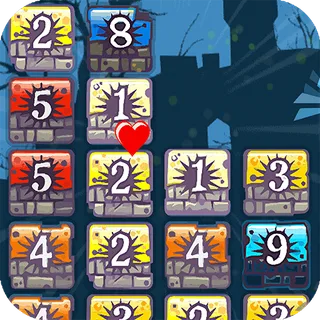
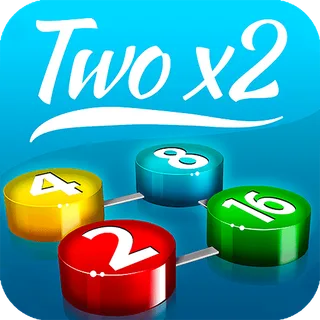
Super Chains links adjoining blocks whose values are equal or one apart, and what it asks for is length. Two x2 takes the doubling from 2048 and throws away the sliding: you connect numbers into a line instead of pushing the whole grid, the longer line scores more, and every connection leaves a doubled number behind. Its publisher names the actual failure condition, which is running out of moves rather than running out of time.
Pudding Monsters has pieces that stick to each other when they meet, and the plan the publisher states is growing them into one large monster instead of leaving a scattered handful. A rule that simple usually means the difficulty has been moved into the arrangements, and an arrangement is a thing you can sit and look at. City Blocks is a match-three that behaves like a zoning board: new buildings arrive, you decide where each one goes, matching sets upgrade into bigger ones, and the limit the publisher names is space rather than time.
Jigsaw Collections is the outlier and belongs here for a reason unrelated to mechanics. A jigsaw is the original leave-it-on-the-table game, and this one has a working surface you can zoom in and out of, which matters far more to the experience than the choice of picture. It is organised into collections rather than one endless stream, so finishing a set gives you a place to stop that the game itself recognises.
What breaks the property
Two things, and both of them are features rather than faults.
The first is a human opponent. Two of the games above offer a pass-the-device mode, and one of those also offers an online one, and in either case the property evaporates, because the other person is a clock. A game that waits patiently for you against the computer will not wait patiently for a friend sitting next to you, and an online match will not wait at all. If leaving mid-game is what you are optimising for, the solo mode is the one to open.
The second is anything with an economy that runs while you are gone. That is the opposite design and it is deliberate: the point is to make coming back the rational thing to do. It is not in this list, and it is not a criticism of it, but it is the other end of the same axis and it is worth knowing which end you have picked up.
What we can and cannot tell you
We can tell you which of these publishers stated a turn structure, and we have quoted or paraphrased those statements rather than inferring them. We can tell you which descriptions name a move-based failure condition — no legal moves, no space left — because that is a structural claim and structure is the one thing readable from outside a game.
We cannot tell you that any of the puzzles in the second group is genuinely untimed, only that nothing in what their publishers wrote suggests otherwise. That gap is the honest size of the evidence, and it will stay that size until somebody sits down with each of them and confirms it. If you want the strongest version of this property today, it is in the first group, where the publishers said it themselves.