What a Thumbnail Can Promise, and What It Cannot
Every game on this site reaches you through two things before you have played a second of it. There is a square image, and there is whatever its publisher wrote about it. Those two artefacts are usually made by different people for different reasons, and when they disagree the image wins, because the image is what you looked at first.
That is a strange amount of weight to put on a picture, and it is worth being precise about how little room the picture actually has.
The physical constraints
The image is square, and it is square at every size, because it is cropped to a square before anything else happens to it. One source image per game arrives from the publisher and is rendered here at three widths: six hundred and forty pixels, three hundred and twenty, and a hundred and sixty. On a phone in a grid of other games, the smallest of those is the size the decision is actually being made at.
The source is also not always generous. The catalogue feed reports a two hundred and fifty pixel version by default, so the sync first goes looking for the publisher’s larger files — a big one, then a medium one — and falls back to the feed’s own two hundred and fifty when neither answers. Where even the largest file the publisher has is smaller than the biggest size rendered here, the extra pixels are interpolated rather than real. So the working assumption should be that a thumbnail is a small square that has to survive being displayed smaller.
Within that budget an image can do about three things. It can name a genre through visual convention. It can establish a tone, which is mostly a question of colour and whether there are faces in it. And it can indicate how much effort went into the presentation, which is the closest thing to a quality signal available before you open anything — with the caveat that it is a signal about the artwork and not about the game underneath.
What it cannot do is tell you a rule. No image has ever communicated a win condition, a control scheme, or how long a session lasts. Those have to come from the words, and the words are where this gets interesting.
When the words add nothing
A surprising number of publisher descriptions add no information to the picture at all.
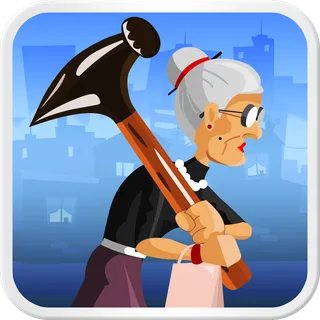
Angry Gran is described entirely as the game that began the Angry Gran series, plus an instruction to go and whack some neighbours. If you know the series, the sentence is redundant. If you do not, it is a reference to something you have not seen and it leaves you exactly where the image left you.
Alpha Guns says it is a side-scrolling shooter with classic gameplay and unique mechanics. The first half of that is a genre you could infer, and the second half is two words that cancel each other out. Unique mechanics is an empty phrase wherever it turns up, because it occupies the exact space where the mechanic should have been named and announces that the space was filled.
Tiger Run defines itself by comparison to a different game that it assumes you have played, which is efficient if you have and useless if you have not. Amaze Escape offers logic, ingenuity and getting out of a prison — a category and a setting, with nothing between them.
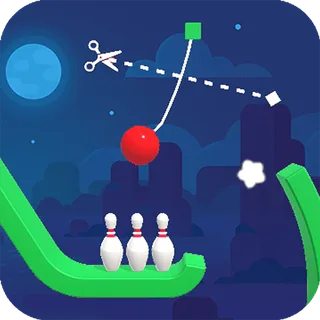
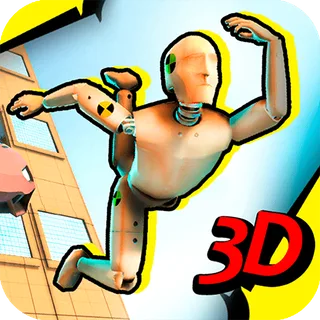
Rope Bowing Puzzle tells you it looks easy but requires concentration, and that there are obstacles to dodge. Read that back and notice that you still cannot say what you would be doing with your hands. Body Drop 3D spends its whole description on the fidelity of its physics and the quality of its animation, which describes a technology rather than a game.
Death Run is the outer limit. Its description reads as though it has passed through a translation and arrived somewhere unusable — it announces a genre, mentions thousands of lives and various agencies, and then stops. Nothing in that sentence can be acted on. Whatever this game is, the image is the only real evidence anybody has.
When the words are for a machine
The opposite failure is rarer and much less obvious, because at a glance it looks like effort.
Cake Shop Cafe Pastries & Waffles cooking Game has a description several hundred words long. It says cake, dessert, bakery, food truck and cooking game so many times that the repetition is clearly the point, and it says the same few facts about serving customers, earning coins and buying upgrades over and over in rearranged order. That text was not written for a reader. It was written for a search index, and its length signals attention while carrying almost none.
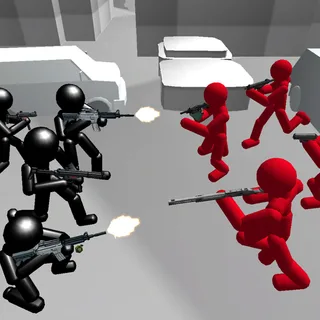
Supermarket Expert Idle opens in the same register — a new adventure is beginning, more departments mean more income — and then does something the rest of this section never gets round to. It stops selling and states the loop: pick products up where they are produced, put them in the right department, check the customers out at the counter. The first half of that description was aimed at a search index. The second half was aimed at a person, and it is the only half worth reading. Fractal Combat X and Battle Simluator - Counter Stickman both reach for feature bullets instead — top-notch graphics, dozens of missions, accurate tactics — which is a format borrowed from app store listings, where it works because it sits under screenshots and a video. Detached from those, a bullet list of superlatives is a shape without contents.
There is one honourable exception on this page. Pigeon Bomber writes its description almost entirely in voice — a short, mock-ominous run of sentences about a pigeon’s grievances — and still manages to state, unambiguously, what you will be doing to the city below. It is the only entry here where personality and information are not competing for the same space.
What the combination actually tells you
The useful reading is not the image or the words but the relationship between them.
A strong image with an empty description is the pairing that tells you the least. It is consistent with a game made by people who could draw, and a listing written afterwards by someone with a different job in a hurry. It is not evidence against the game. It is simply not evidence for anything.
A weak image with a detailed, specific description is rarer and more interesting, because writing precisely about your own mechanics takes longer than writing superlatives and there is no commercial reason to do it unless the mechanics are the thing you are proud of.
And a strong image with a long keyword-stuffed description is the one combination that should actually lower your expectations, because both artefacts have then been optimised for the click rather than for the person arriving after it.
What we cannot do here
We have not described a single one of these thumbnails, and that is deliberate. Nobody writing this page has seen them, and a sentence about what an image depicts is exactly the kind of small confident claim that turns out to be wrong. The sizes and the constraints above are properties of the pipeline and can be checked. The pictures themselves are on the game pages, at the size you would actually see them, which is a better place to judge them than a paragraph here.
What we can tell you is what the words are worth, because the words are text and text can be read carefully. On this page, mostly, they are worth very little.