One Attempt at a Time: Arcade Games Built Around the Restart
The arcade cabinet charged by the attempt, and the design followed from the billing. A run had to be short enough that failure did not feel like a waste of an evening, and severe enough that the machine got another coin out of it. Nothing about that arrangement survives in a browser, where the coin slot is gone and the restart is free, but the shape it produced did survive, and it is the most common shape in this category.
What that means practically is that the interesting question about an arcade game is not what you do in it. It is what ends it. The failure condition is where the design is actually stated, and when a publisher describes anything precisely it tends to be that, because it is the thing they had to build first. When they leave it out, the omission is worth just as much attention, and several of the games below leave it out.
Contact ends it
The oldest failure condition is touching the wrong thing.
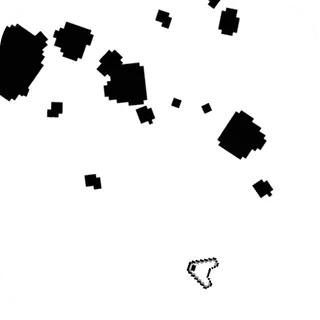
Pixeroids states its entire design in one line: guide a ship, destroy asteroids, do not collide with them. Shooting is the scoring action and touching a rock is the end of the attempt, which means the same objects are both the point of the game and the thing that ends it. What a destroyed asteroid leaves behind is the one detail that would decide how a run actually unfolds, and it is not something the publisher says.
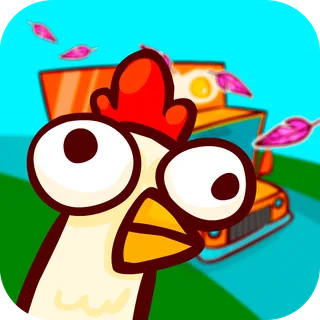
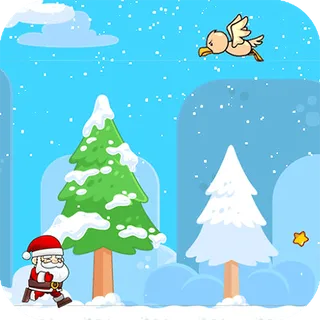
Go Chicken Go is the road-crossing design, and its publisher asks for two things at once: cold blood and truck-dodging skill. Twenty-five chickens have escaped a farm, the only thing between them and open country is a highway, and the traffic does not care which of the two you are short of. Mr Santa Run 2 is the runner reduced to its parts: keep moving, avoid what is in the way, collect the thing that increases the number. Nobody is pretending it is more than that, and the description is short enough to prove it.
Geometrical Dash narrows the whole game to a single verb. You control a square, the only thing its publisher says you need to do is jump, and the levels are described as pixel-perfect mazes built to test reflexes, with the jumping timed to the music. Its publisher never actually spells out what ends a run, and it barely has to. When the only thing you decide is when to leave the ground, a failure is a mistimed jump and you know exactly which one it was.
Keeping hold of it
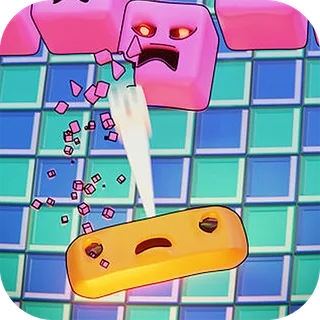
Face Breaker is a paddle-and-blocks game with one detail that changes everything about how a run feels: the publisher states that the ball gains speed after every bounce. That makes the difficulty a function of how long you have kept the ball alive rather than of which level you happen to be on. Every rally you win makes the next one faster, so competence is repaid in speed, and a good run and a hard run turn out to be the same run. The publisher states the ending just as plainly: if the ball falls past the bottom, that is the attempt over.
Stacky Dash Nail works on accumulation rather than reflex — you build up a stack, and its length sets the reward for the level. It is here on the strength of that scale and not much else. The publisher documents what a long stack is worth and never says what happens to one, which leaves the most interesting question about the design, whether a stack can be lost, completely unanswered.
One input decides it
Two games here compress the whole run into a single input, repeated.
The Eggsecutioner is as reduced as anything in the catalogue: a marker travels along a bar, and you stop it in the middle. That is the game. There is a whole family of these, and they persist because a one-input design is legible in about a second and can be made arbitrarily hard by moving one number.
Drunken Duel is a western shootout between two ragdolls with one-button physics-based control. Its publisher is unusually frank about the arc: you can hit the target by firing at random and you can lose that way too, and taking a more professional shot becomes possible once you have played a few times and understood how the physics behaves. That is a description of learning, written by someone who knew that early runs are supposed to be bad ones.
Losing the race ends it
Final Freeway is a stage-based arcade road racer, and the failure condition its publisher names is the clock: beat it to each goal and the run continues into the next stage. This is the arcade racing contract in its original form, and it is the one design where the countdown is not an imposition but the entire premise. Without it there is no race, only driving.
The hazards that look back
Smart Looter inverts the usual relationship with the hazards. The things to avoid are patrols, and the instruction is to be quick and sneaky rather than fast and accurate, which points at a game about timing and position instead of reflexes. What the publisher never says is what a patrol does once it has noticed you, so this one is filed here on a genre convention rather than on anything documented — which is worth stating outright, because it is exactly the sort of gap that gets quietly filled in elsewhere.
Letting something through ends it
Line of Defense has the most specific failure condition on this page, and it has two of them. Tanks approach a front line in different colours, and your rockets are also coloured; fire the wrong colour at a tank and you lose, and let a tank reach the line and you lose. Those are two distinct ways to be punished for the same lapse of attention, one for acting wrongly and one for not acting at all, and having both is what stops the game from being solvable by spamming.
Fruit Blaster sits next to it in shape only. Its publisher gives you the design in four words — slice fruit, be fast — then a score and a combo, and stops. Nothing in it says what a missed piece costs, which is a conspicuous omission in a game whose whole appeal is that fruit keeps arriving whether or not you are ready for it.
Why the restart is the point
Most of these games have no ending, and the ones that do — Face Breaker counts out forty-five levels, Final Freeway a sequence of stages — still put the run at the centre of it. There is a score, there is the attempt that produced it, and then there is another attempt. The reason that works in a browser tab is the same reason it worked in a cabinet: the cost of trying again is close to zero, and a design that can only be learned by failing needs failure to be cheap.
The difference is that the cabinet took your money and the tab takes your afternoon, and only one of those two gives you a receipt.
What we have not checked
Everything above is drawn from what each publisher documents about their own game and from how the catalogue files it. We can describe what a game asks of you and what it says will end your attempt, because those are claims a publisher makes in writing and we can hold them to.
We have not played these. We cannot tell you how many attempts it takes before a run stops being embarrassing, whether the difficulty is fairly tuned, or which of them is still interesting on the twentieth try. Nor, in the several cases flagged above, can we tell you what ends the attempt, because nobody wrote it down. Those are the questions that matter most about an arcade game and they are the ones a description cannot answer. The good news is that the format answers them faster than any review can: an attempt is short by construction, and you will know.